


With property prices falling across much of Australia and changes to negative gearing on the horizon, it’s understandable that some investors are questioning whether now is the right time to buy.
Two concerns keep coming up in conversations about property investment:
- The property market is going backwards. Why would I invest now?
- With negative gearing changing, is property investment still worthwhile?
Both are reasonable questions. The answer requires a closer look at what’s actually happening in the market, how the tax changes work and what makes a property a sound long-term investment.
Concern #1: The property market is going backwards
There’s no denying that Australian property prices have been falling.
According to RP Data’s September 2026 Home Value Index, national dwelling values declined 1.1% during September, marking the sixth consecutive monthly fall. Values were 5.2% below their March 2026 peak.
For anyone considering investing, those figures can be unsettling. However, national averages are only part of the picture.
Over the 12 months to September 2026, property values across our capital cities performed very differently:
- Darwin: +11.9%
- Perth: +10.1%
- Hobart: +7.0%
- Adelaide: +6.5%
- Brisbane: +5.9%
- Melbourne: -6.2%
- Sydney: -7.0%
While Sydney and Melbourne recorded annual declines, several other capital cities remained ahead of their September 2025 values.
However, national and capital city figures only tell part of the story. Looking more closely at individual suburbs reveals pockets of growth, even in the months following the May 2026 Federal Budget announcements.
In some locations, strong housing demand relative to available supply continues to support property values.
We’ve seen this firsthand in locations where Equidel clients have invested.
In Victoria, two suburbs have recorded growth of 1.43% and 4.13% respectively over the past five months. One is located west of Melbourne, while the other is benefiting from investment in a major hospital upgrade.
In Queensland, suburbs where Equidel clients have invested have also performed positively since May, recording growth of 2.38% and 8.90% over the same period.
These examples highlight why Equidel places so much emphasis on location research.
Rather than relying on broad market trends, we look at the fundamentals driving demand in individual locations. Is the population growing? Are employment opportunities expanding? What infrastructure investment is planned? How much housing is available, and what does rental demand look like?
By examining these factors, we can identify locations with the underlying conditions to support long-term property investment.
A declining national market doesn’t mean every suburb is declining, just as a growing market doesn’t guarantee every property will perform well. Understanding the difference is where thorough research becomes invaluable.
What about rental demand?
Another important consideration is that property prices and rental demand don’t necessarily move together.
While national dwelling values fell in September, RP Data reported that rents had increased 5.5% over the preceding 12 months.
People still need somewhere to live, regardless of whether property prices are rising or falling.
For investors, rental demand is an important part of the equation. A property needs to attract tenants, generate income and remain financially manageable throughout the investment period.
Of course, strong rental demand alone isn’t enough to justify a purchase. The price paid, likely rental return, ongoing expenses and prospects for future growth all need to be considered.
This is particularly important in the current environment, where borrowing costs and holding expenses can place additional pressure on investment cash flow.
Concern #2: Negative gearing is changing. Is property investment still worthwhile?
The Federal Government’s changes to negative gearing have understandably raised questions among existing and prospective property investors.
However, the changes don’t affect every property in the same way.
Under legislation passed in 2026, from 1 July 2027, investors who purchase established residential investment properties after 7:30pm AEST on 12 May 2026 will generally no longer be able to offset rental property losses against their salary or other non-property income.
Instead, those losses will be restricted to certain residential property income and capital gains, with unused amounts able to be carried forward.
Importantly, existing investments acquired before the cut-off retain their previous treatment, and eligible newly built residential properties are exempt from the new negative gearing restrictions.
That distinction is particularly relevant to Equidel.
We focus exclusively on new-build investment properties, an approach that aligns with the Federal Government’s broader objective of increasing Australia’s housing supply. With government policy encouraging investment in new housing, new-build properties remain an important part of the conversation around negative gearing and property investment.
This means the properties we assess may continue to qualify for negative gearing treatment that will no longer be available to many newly purchased established properties.
For investors concerned about the reforms, understanding the difference between new and established properties is an important starting point.
There is also a broader point worth making.
Tax benefits should support an investment strategy, rather than be the reason for making an investment in the first place.
Even where negative gearing remains available, investors still need to consider their borrowing capacity, rental income, cash flow, holding costs and long-term objectives.
The changes make it even more important to understand exactly what you’re buying and how it fits into your financial circumstances.
Investors should seek advice from a qualified tax professional about how the reforms apply to their individual circumstances.
We’ve seen uncertainty in property before
Think back to 2020, when COVID-19 created enormous uncertainty across Australia’s economy.
At the time, many prospective property buyers were understandably hesitant. Nobody knew exactly how the pandemic would affect employment, housing demand or property values.
While many existing Equidel clients continued to invest throughout 2020, uncertainty in the property market meant that just two new clients chose to move forward with an investment property purchase during this period.
After reviewing their circumstances and the research supporting their selected properties, both decided to proceed.
As the property market subsequently recovered, those investments experienced capital growth at record rates. One Equidel client purchased an investment property for $437,000 in 2020, and the ensuing growth in that market can be seen in the chart below:
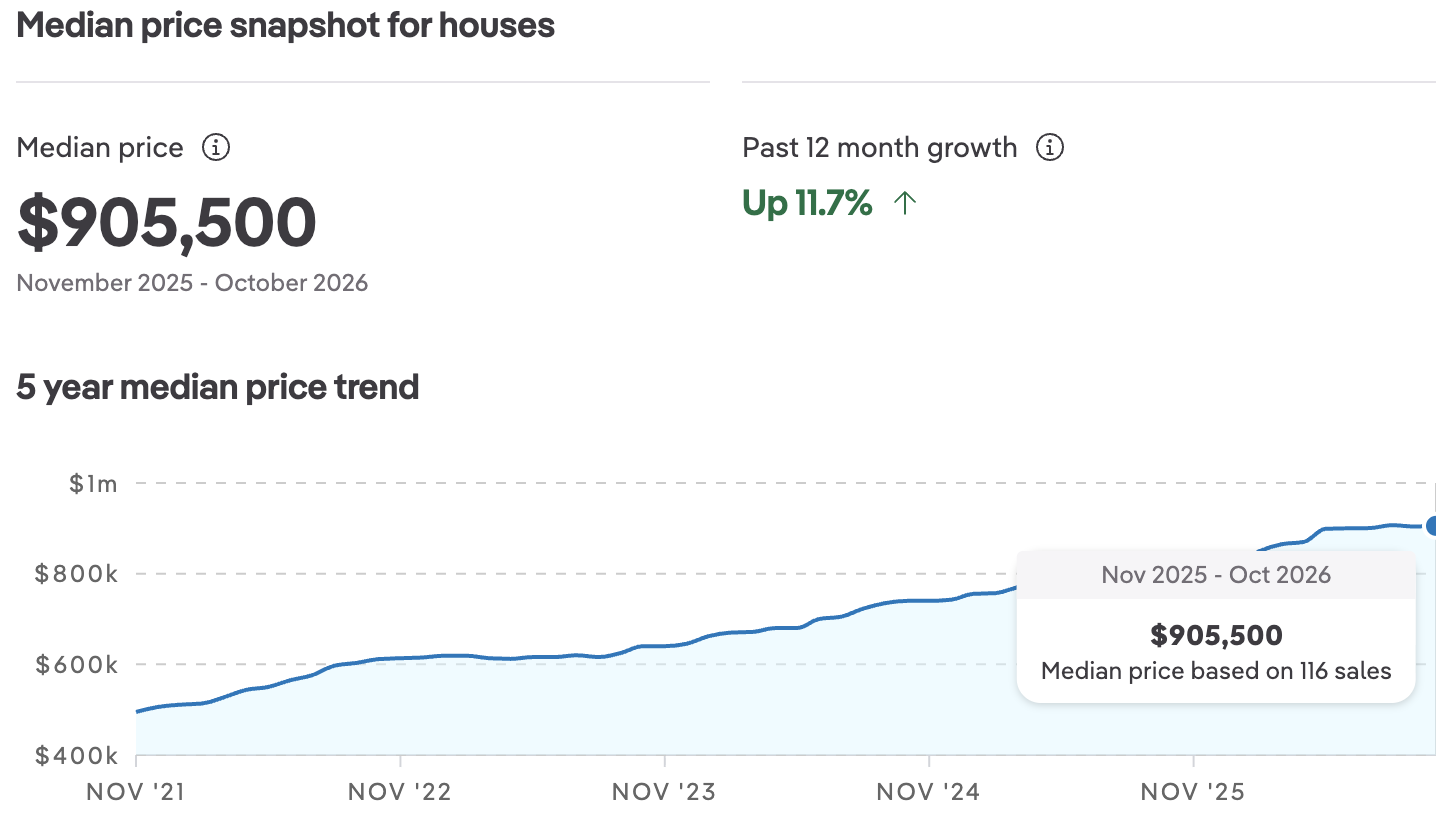
Their experience is a useful reminder that periods of uncertainty don’t necessarily mean investors should abandon their plans.
It also demonstrates why the research behind a property purchase matters.
Neither client could have known exactly how the market would perform. Their decisions were based on the information available, their individual circumstances and the long-term fundamentals of the properties being considered.
Research matters more than market sentiment
Property investment has always involved risk, and the current market is no exception.
What concerns us is when investors make decisions based primarily on headlines, predictions or what everyone else seems to be doing.
At Equidel, we take a research-led approach to identifying investment opportunities.
Our Property Analysis Matrix has been developed using historical property data and assesses opportunities against multiple criteria, including population trends, employment diversity, local market conditions and property characteristics.
We then consider how a potential investment aligns with the individual investor’s circumstances and objectives.
This process doesn’t remove investment risk or guarantee future performance. It does, however, provide a more informed basis for deciding whether a property is worth considering.
So, is it still worth investing in property?
For some investors, the current environment may be a reason to reconsider their timing, borrowing capacity or investment strategy.
For others, there may still be opportunities worth investigating.
The Australian property market is experiencing a period of adjustment, and the negative gearing reforms introduce another consideration for anyone planning to invest.
Neither development means property investment has ceased to be viable.
The key is understanding which locations and properties have the fundamentals to support a long-term investment, and whether the numbers make sense for your circumstances.
At Equidel, we help investors make those decisions with research, analysis and a clear understanding of the opportunities and risks involved.
Considering property investment but concerned about the current market or negative gearing changes?
Talk to Equidel about how our research-led approach can help you make an informed decision.


Comments are closed.