

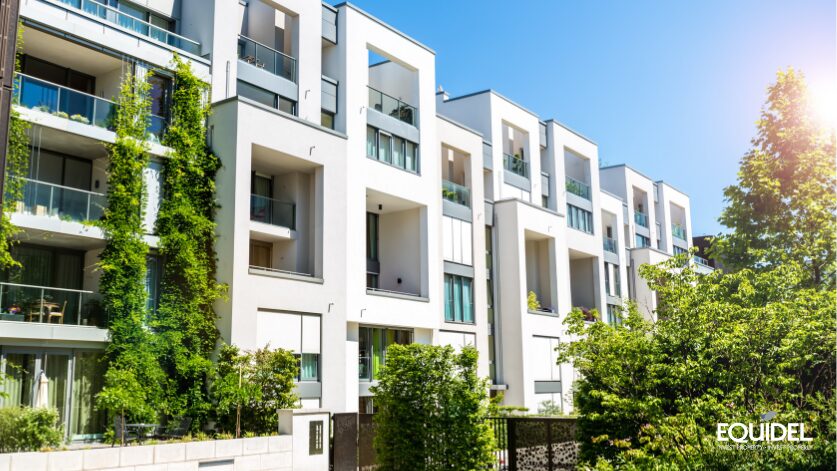
When property investors talk strategy, one question comes up almost every time: “Should I buy a house or an apartment?”
At Equidel, we always start with data, not opinions. And over the long term, the numbers are very clear.
Across Australia, house values have outpaced units for capital growth. CoreLogic-based analysis shows national house prices rising around 382% since the early 1990s, compared with about 213% for units over the same period.
Longer-term studies of the housing market also show that while house and unit prices grew at similar rates in earlier decades, house prices have pulled ahead significantly since the early 2000s.
So why does this gap exist, and does it mean apartments are always the wrong choice? Not necessarily. But you need to understand what’s really driving the returns.
Why the land component matters so much
There’s an old line in property: the best investment on earth is earth.
Buildings wear out. Kitchens, bathrooms and roofs all depreciate over time. Land does the opposite. It tends to appreciate, especially in locations where population, jobs and infrastructure are growing.
Major research into Australian housing shows that most of the difference in long-term price growth between houses and apartments comes down to land value.
Owners of houses capture more of that rising land value than unit owners, simply because houses usually sit on a larger share of land in the total asset.
- Houses (Torrens title): you own the land and the building.
- Apartments: you own part of the building and a small, shared slice of land with many other owners.
Over a 10–30 year horizon, it’s the land that does most of the heavy lifting for capital growth. That’s a big reason why, when we model outcomes over time, houses generally come out ahead.
Apartments: Lower entry price, higher running costs
Apartments still appeal for good reasons, especially for first-time investors or those with tighter borrowing capacity:
- Lower entry price – the deposit hurdle is often more manageable.
- Attractive headline yields – rent can look strong relative to the purchase price.
But there are trade-offs you can’t ignore:
- Very limited (to none) individual land component in the asset
- Ongoing strata and body corporate fees
- Potential special levies and contributions to sinking funds
- More exposure to oversupply, especially in high-density precincts with lots of similar stock
Those extra costs eat into your net yield over time. And when a new wave of developments hits the market, your apartment may have to compete harder for both tenants and buyers.
This is why, when we put assets through the Equidel Property Analysis Matrix, houses “stack up” better more often than not. They combine an appreciating land component with fewer shared outgoings and, in the right locations, strong and resilient tenant demand.
Why location still beats asset type
Asset type matters, but location matters more.

Long-term Australian housing research consistently points to three big growth drivers:
- Population growth
- Job and industry diversity
- Scarcity of well-located land
That’s why, at Equidel, we spend as much time on where, as on what:
- Is there diverse, growing employment nearby?
- Are there quality schools, universities and hospitals supporting demand?
- Is infrastructure improving – roads, rail, lifestyle precincts, services?
- What does supply vs demand look like over the next decade?
In markets where demand is strong and new supply is constrained; a well-selected apartment can still perform. In contrast, a freestanding house in a one-industry town with falling population may struggle, land component or not.
Our Property Analysis Matrix weights all of these factors, not just “house vs unit”, so we can compare opportunities objectively across Australia.
How Equidel typically approaches houses vs apartments
Broadly, our default setting is:
We tend to favour houses (Torrens titled) for most clients because:
- The land component has historically delivered stronger capital growth.
- Outgoings are simpler and usually lower (no body corporate or large levies).
- There’s more scope to add value through renovations, extensions or improvements.
We still consider apartments when:
- They are in tightly held, high-demand suburbs with limited new supply.
- The numbers pass our Matrix on growth, not just yield.
- A client’s budget or borrowing capacity makes a high-quality unit the best strategic first step.
The goal isn’t to declare one asset type “always better”. The goal is to choose the structure that gives you the best chance of compounding returns over time, with a risk profile you’re comfortable with.
So, which is smarter for you?
Across most Australian cities, the data shows houses have delivered superior long-term growth compared with apartments. Land value and lower exposure to oversupply are the key reasons.
But there is no one-size-fits-all answer. The smarter choice depends on:
- Your current financial position and borrowing capacity
- How long you have to invest before you need the capital back
- Your risk tolerance and cash-flow needs
- The specific markets and suburbs under consideration
At Equidel, we start with your numbers and goals, then use our Property Analysis Matrix to weigh up location, asset type and risk, so you don’t have to guess.
If you’d like to explore whether a house, an apartment, or a mix over time, makes the most sense for your strategy, get in touch with the Equidel team. We’ll walk you through the data and help you make a confident, evidence-based decision about your next investment.